Summary
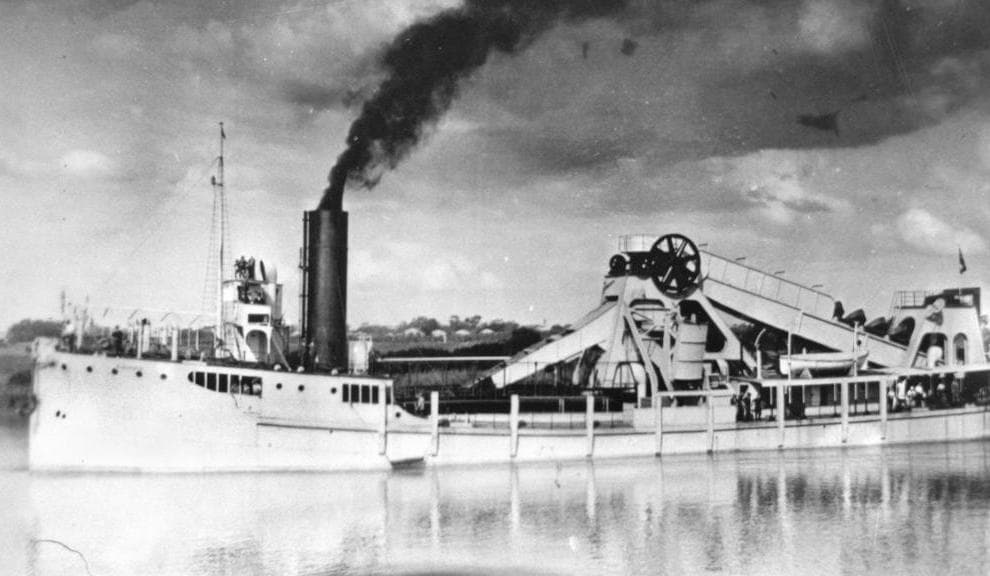
The dredge vessel 'Platypus' was constructed in 1883 by Messrs. William Simons and Co. of Renfrew, Renfrewshire, Scotland on behalf of the Queensland Government, and it made its way to Brisbane, Queensland, Australia by the middle of 1884. It operated along the Queensland coast and played an instrumental role in establishing the port of Cairns. The ship also contributed to key developmental projects in Townsville and carved out channels at various locations including Normanton, Port Douglas, Thursday Island, Cooktown, and Brisbane.
The 'Platypus' was retired from service in December 1923, and by 1926 it was stripped of all valuable equipment at a dry dock in South Brisbane. In October 1926, after 42 years spent dredging harbours and tidal rivers across Queensland, the 'Platypus' was intentionally sunk at the south-eastern point of Peel Island to create a breakwater at the lazaret. Its purpose was to shield passenger and motor boats docking at the jetty from strong south-easterly winds. The ship's successor, the 'Platypus II', was already under construction when its 'Platypus' met its end.
Timeline
The below timeline contains notable dates found in records online. As more information is found this table will be updated.
| Year | Event |
|---|---|
| 1883 | Built by Messrs. William Simons and Co. in Renfrew, Glasgow, Scotland[1][2] at London Works Yard, Yard No. 235[3]. She was built for the Queensland Government at a cost of £33,550[4]. |
| 1884 | June 27th - Arrived off Cape Moreton, Brisbane at 9.45 a.m[5]. June 28th - First mention in the Brisbane newspapers, expecting it to arrive in Brisbane port that morning. Also contains an extract from the Engineering report from shipbuilders, Messrs. William Simons and Co[5]. November - Began dredging in Townsville[6]. |
| 1889 | Was joined in Townsville by another bucket-ladder dredge, the 'Octopus'[6]. |
| 1897 | December - Captain Evans appointed to take charge of the dredge[7]. |
| 1905 | Legislative Assembly Hansard[7]. "Mr Woods" (assumed to be Michael Joyce Reginald Woods[8], Member of the Queensland Legislative Assembly, 1902–1909) asked questions to the Treasurer regarding the Platypus and Captain Evans. |
| c.1888 | Collision with the coastal steamer Tinana while crossing Moreton Bay; sustained little damage[9]. Note: the Brisbane Courier (13 October 1926) places this "38 years ago," pointing to circa 1888; the date 1908 sometimes cited appears to be a misreading. |
| 1923 | December - Decommissioned[9]. |
| 1926 | October 21st - Stripped of gear and scuttled at Peel Island to make a breakwater at the lazaret[4][2]. |
| 1932 | British registry closed[3]. |
Platypus engineering
The Platypus, a Dredge Bucket iron screw steamer, was launched on the 17th of November, 1883. The vessel was assigned the official number '87316'. The shipbuilding firm William Simons & Co. Ltd., based at the London Works Yard in Renfrew, Renfrewshire, Scotland (Yard No. 235)[3], was responsible for its construction. Note: Renfrew is a separate town on the south bank of the River Clyde, approximately 10 km west of Glasgow; the two are distinct, though both are part of the broader Clyde shipbuilding region. William Simons & Co. was founded in 1810 and by the mid-19th century had established itself as one of the world's foremost builders of dredging vessels, eventually supplying governments across Britain, Australia, Brazil, Canada, China, Egypt, France, India, Japan, and many other nations[10]. By the time the Platypus was built she was the firm's eighteenth hopper dredge, and by the time of William Simons's death in 1902 over 420 vessels had been completed at the yard.
The Platypus is correctly described as a self-propelled twin-screw bucket-ladder hopper dredger — a description that combines two distinct technical features that are entirely compatible:
- Bucket-ladder: the excavation mechanism — an endless chain of steel buckets revolving on a ladder that scoops material from the seabed and deposits it via a chute into the vessel's internal hold.
- Hopper dredger: the spoil-disposal method — dredged material is stored in an integral hold (the hopper or well) within the hull, allowing the vessel to carry her own spoil to a dumping ground without needing a separate barge alongside.
- Twin-screw, self-propelled: unlike most contemporary bucket-ladder dredges, which were stationary pontoons moved by anchors and winches, the Platypus could steam independently along the coast between work sites — a crucial capability for operating across Queensland's vast distances.
This combination made her unusually innovative for 1883 and is the reason the Queensland Government paid £33,550 for her — a substantial sum for the era.
The Platypus boasted substantial dimensions; it had a tonnage of 818 gross register tons (grt) / 399 net register tons (nrt), a length of 189 feet, a breadth of 38.7 feet and a depth of 14.2 feet[3]. This vessel was first registered in Brisbane on the 26th of July, 1884[3].
The Brisbane Courier, Sat 28 Jun 1884[5], wrote 'The Engineering of the 25th January thus refers to this vessel:'
The twin screw hopper dredger Platypus, recently launched by Messrs W Simon and Co., Renfrew, steamed down the river on Saturday last, and moored opposite Garvel Dock, Greenock. After filling her hopper with nearly 1000 tons of dredgings, at the rate of 500 tons per hour, the vessel lifted its bucket-girder and steamed to Lochlong, where her load was instantly deposited. A speed of ten miles per hour was obtained.[5]
The Platypus has an awning deck, and has been constructed for the Queensland Government for the purpose of deepening the rivers and bars at the Northern ports of Queensland, and is intended to steam considerable distances along that coast. This is the eighteenth hopper dredger this firm has designed and constructed, and is in all respects one of the most complete and powerful dredgers afloat.[5]
She is fitted with the builders' traversing bucket ladder, in order to cut her own flotation through shoals and banks. The buckets, wheels, and frictions are all of steel. There are powerful triple independent steam crabs fore and aft, hydraulic ladder hoist gear, a complete workshop for repairs, consisting of turning lathes, drilling machines, and planing machine, and two smiths' hearths with Root's blowers, all driven by steam power. The machinery for propelling the vessel consists of two independent sets of compound surface-condensing 500-horse power. The boilers are made entirely of steel, and are of such dimensions that the working pressure of [text appears corrupted/truncated in transcription] and apertures closed up, the vessel was masted and loaded with coal, and proceeded under steam to Brisbane, via the Suez Canal.[5]
Note: the third paragraph of this extract contains a clear transcription gap — the text breaks between "working pressure of" and "apertures closed up," omitting what appears to be several sentences describing the boiler specifications. The original newspaper text should be consulted for the complete passage.
Townsville, Cairns, and Cooktown
In November 1884, the Platypus arrived in Cleveland Bay to begin the first major dredging of what would become the Port of Townsville[6]. A dredging operation was initiated with the aim of accommodating larger ships within the port's confines. This marked a significant milestone in Townsville's maritime history. The channel carved out by the Platypus bears her name to this day: the modern Townsville shipping channel is 14.9 km long[11] and is divided into three sections — the Sea Channel and two sub-sections known as the Outer Platypus Channel and the Inner Platypus Channel — both named directly in honour of the dredge[11].
The Platypus played an instrumental role in these early days of expansion. Unlike most contemporary bucket-ladder dredges — which were stationary pontoons moved by anchors and winches — the Platypus was a self-propelled hopper dredger, meaning she could both excavate and carry her own spoil in her internal hold (the hopper), depositing it at sea without needing a separate barge alongside[6]. This allowed her to travel independently between Queensland's widely separated ports. The year 1889 welcomed another addition to this industrious fleet - 'Octopus'[6]. Much like the Platypus, Octopus was also a bucket-ladder dredge, further contributing to Townsville's maritime progress and expansion. A model of the Octopus is on display at the Maritime Museum of Townsville[6].
After Townsville, the Platypus moved to Cairns, arriving in November 1887. The dredging campaign of 1887–88 was pivotal: in the words of the Brisbane Courier (13 October 1926), the Platypus "began her long work on the Queensland coast by opening up the port of Cairns." Cairns at this time was competing fiercely with Port Douglas for dominance of Far North Queensland, and the Platypus's work — making the harbour accessible to larger vessels — played a material role in Cairns winning that competition and becoming the region's principal port[12].
Legislative Assembly Hansard 1905
I found this next section to be simply interesting. The following was taken Qld Parliament Documents, Parliamentary Debates, Legislative Assembly Hansard 1905, Page 178 (PDF page 2 of 2)[7].
Several references in this exchange require context:
- "Norman Bar" / "Karumba" — The Norman River bar at Karumba, at the mouth of the Norman River on the Gulf of Carpentaria. A remote and difficult navigation with tidal bars, approximately 2,000 km from Brisbane by sea.
- "Inner Route" — The navigable corridor between the Queensland coast and the outer Great Barrier Reef, stretching approximately 2,000 km from Gladstone to Torres Strait. In 1905 it was the only viable shipping lane for Queensland's northern ports (Cairns, Thursday Island, Normanton). It required pilots experienced with its complex reefs, shoals, and tidal passes — hence the Treasurer's answer that "practically all vessels take a pilot through the Inner Route."[13]
- "Clermont Lightship" — A lightship stationed on a hazard in the Inner Route passage north of Bowen; running the Platypus onto a reef near a lightship "in broad daylight" would have been a particularly embarrassing incident.
- Captain Evans' succession — Evans was retained after the 1905 inquiry. He was subsequently succeeded as master by Lawson, then Williams, and finally Captain Madams, who retired approximately three years before the vessel was decommissioned in December 1923.
Parliamentary Debates
(Hansard)
Legislative Assembly
THURSDAY, 19 JANUARY 1905THE CAPTAIN OF THE DREDGE "PLATYPUS." Mr. WOODS asked the Treasurer-
- When was Captain Evans appointed to take charge of the dredge "Platypus"?
- What are his qualifications for occupying the position of dredgemaster?
- Upon whose recommendation was he appointed?
- Did he ever have any previous experience of a dredging plant?
- Is it true that Captain King was sent specially from Brisbane to Karumba, Norman Bar, to take charge of the dredge "Platypus" and plant as navigating master, and to navigate same from Norman Bar to Thursday Island and from there to Port Douglas?
- If Captain Evans is competent, why was it necessary to send another captain to the Norman Bar to navigate the "Platypus;" and if incompetent, why is he retained?
- Is the Minister aware that on the voyage of this dredge to the Norman Bar when Captain Evans was navigating the plant he ran it on a chartered reef near the Clermont Lightship in broad daylight?
- Does this occurrence appear in the ship's log?
- Does the Minister consider it necessary to retain the services of a navigating master on any of the dredging plants in the present financial position of the State?
- Is the Minister aware that in New South Wales the chief engineer is master of the plant?
- Is the Minister aware that there has been considerable friction between Captain Evans and the dredge employees, and that liquor was sold on the launch to the employees with the full knowledge of the dredgemaster?
- What explanation did Captain Evans make in connection with the drowning of one of the dredge hands in the Norman River during the Easter holidays last year?
The TREASURER (Hon, W. Kidston, Rockhampton) replied-
- December, 1897.
- He is a master mariner, and works his dredge satisfactorily.
- The late Captain Almond recommended his appointment.
- Not known.
- Yes; to act as pilot through the Inner Route.
- Practically all vessels take a pilot through the Inner Route, and, as the plant was not insured, the department considered the course adopted advisable.
- Yes.
- Yes.
- All dredges must have an officer in charge, and it is considered that under the conditions obtaining here a nautical man is preferable. Sea-going dredges must have a navigating master.
- Details of the New South Wales dredge service are not available.
- The only disputes known were in connection with overtime; these were settled. Nothing is known as to the purchase of liquor by the employees.
- The occurrence was duly entered in the log-book. As a magisterial inquiry was held at Normanton the department did not take further action. Captain Evans was on board the dredge at the time.
Wreck
As December 1923 arrived, the Platypus was decommissioned after 42 years of service. The once powerful vessel was escorted to a dry dock in South Brisbane, where she was carefully stripped of all valuable equipment. By October 1926 nothing remained but an empty hull.
On 21 October 1926, the Platypus was intentionally scuttled at the south-eastern point of Peel Island, Moreton Bay, to serve as a breakwater for the jetty at the island's lazaret.
The Peel Island Lazaret
To understand why a breakwater was needed at Peel Island, context about the lazaret is essential — it is entirely absent from most accounts of the Platypus.
Peel Island (Quandamooka name: Teerk Roo Ra, meaning "place of many shells") had been used since the 1880s as a quarantine station. In 1907, the Queensland Government established a dedicated lazaret (leprosy isolation facility) on the island, replacing earlier, ad hoc facilities at Friday Island and Dunwich. It became Australia's first purpose-built multi-racial lazaret, opening with 71 patients[14].
Leprosy (Hansen's Disease) had entered Queensland primarily via Chinese workers during the 1850s gold rush. Under the Queensland Leprosy Act of 1892, anyone diagnosed with leprosy could be compulsorily removed from their home and transported to the lazaret indefinitely. Over the lazaret's 52-year operation, approximately 500 people passed through Peel Island[14].
The facility was racially segregated: white patients received substantially superior accommodation, cooking, and washing facilities; non-white patients initially received none. In January 1940, all non-white patients were transferred under police escort to Fantome Island (off Townsville), where conditions were considerably worse and mortality rates were high[14]. The Peel Island lazaret then served white patients only until its closure in 1959, after which the remaining patients were transferred to Princess Alexandra Hospital in Brisbane.
The stone jetty on Peel Island's eastern shore dated from the quarantine station era and was the island's only connection to the outside world — all supplies, medical visitors, and new patients arrived by this route. The island's south-eastern aspect left the jetty exposed to the prevailing south-easterly trade winds, making small vessel approaches hazardous. The Platypus was scuttled specifically to create a sheltered anchorage for the supply launches and motor boats serving the lazaret's patients.
The Platypus was the sole vessel scuttled as a breakwater for the Peel Island lazaret; it should not be confused with the Tangalooma Wrecks (15 vessels scuttled 1963–1984 on Moreton Island's western shore for recreational anchorage) or the Bulwer Wrecks (three vessels scuttled circa 1930–1931 at Comboyuro Point, also on Moreton Island).
Platypus II
The Platypus's successor, Platypus II, was already under construction at the time of the scuttling and was completed in 1927. She differed from her predecessor in one notable respect: her hopper (spoil-holding well) was located in the stern rather than in the bow as on the original Platypus. Platypus II served Queensland ports for several decades before meeting her own end: she was scuttled in 1966 as part of the Tangalooma Wrecks on the western shore of Moreton Island, where she lies today as a popular snorkelling and dive site at depths to approximately 12 metres[15].