The idea
In 1967 members of the Underwater Research Group of Queensland (URGQ) decided Brisbane needed a dive site of its own. They surveyed a patch of bare sand on the inner side of Moreton Island, counted two species of fish on it, got permission, and on 12 August 1968 sank an old dredging barge, the Amsterdam. The club has called it the world's first artificial reef built by divers for divers.
Over the next thirty years they added about twenty-five vessels: gravel and coal barges, tugs, sand carriers, a concrete-hulled yacht, a coastal trader, a car ferry, a dry-dock gate, an old Brisbane tram, and two whale chasers from the whaling station a few kilometres south at Tangalooma. Between the vessels went pontoons, navigation buoys, car bodies, concrete pipes and old tyres. The last vessel, Hustler, went down in 1998.
Every vessel was bought, stripped and sunk by club members. Frank Curtin did the organising and, when the time came, the explosives, and the reef carries his name. URGQ also credits Linton Holroyd for the years of work behind it.
The wrecks
The vessels lie on sand in a rough north–south line, close enough that a single dive covers four or five of them.
| Vessel | What it was | Notes |
|---|---|---|
| Melbourne | 35 m tug | Near the centre of the site, about 25 m. Once penetrable, now full of sand |
| Barrambin | 32 m coal and gravel barge, 228 t, built 1943–44 | Just south of the Melbourne; scuttled 1 August 1987. A club-built observation station on her deck has fallen on its side |
| Bremer | 50 m coal barge | Usually quoted as the largest wreck on the reef |
| Amsterdam | Dredging barge | The first, 1968 |
| Estrella del Mar | Gravel barge | North of the Melbourne |
| Lovenstein | Tug | North of the Melbourne |
| Cairncross dock gate | Dry-dock gate from the Brisbane River | North of the Melbourne |
| Lady Norman | 40 m coastal trader | Sits alone about 50 m west of the Melbourne; easy to miss |
| Kos I, Kos II | Whale chasers | From the Tangalooma whaling station (1952–62) |
| Point Lookout | Car ferry | |
| Centipede | Whale-oil carrier | |
| Solace | 10 m concrete yacht | The smallest |
| Hustler | The last, 1998 | |
| Brisbane tram | Buried and uncovered by the sand several times | |
| Nautilus statue | Concrete statue of a video-game character, 2016 | Just east of the Rock Driller at the southern end; see Nautilus Reef Statue |
Most vessels still carry their props, and the barges' open hulls are cavernous. The sand moves with every storm and tide, so the site is never quite the same twice: wrecks are buried and re-exposed, and the interiors of most have filled in. URGQ's advice is not to penetrate. After more than fifty years everything is coated in hard and soft corals, black coral trees, gorgonians, sponges and ascidians, and in places stinging hydroids, so mind your hands.
Marine life
The bare sand of 1967 now holds several hundred fish species. The residents are the Queensland grouper: dozens of them, one to two metres long and occasionally three, which meet divers on the descent and follow them from wreck to wreck. Barracuda, giant trevally, kingfish, cobia and goldspotted grouper are common; stingrays rest on the sand beside the hulls; turtles and spotted wobbegongs are regulars, with leopard sharks in season.
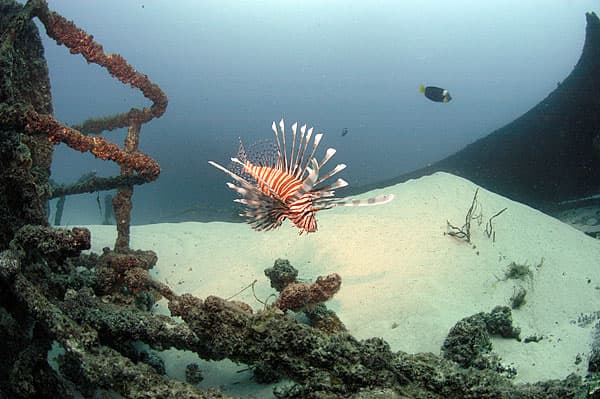
Because the reef sits in the estuarine waters of the bay rather than on the open coast, it turns up things you would not expect: stonefish, demon stingers, leaf scorpionfish, painted frogfish, ornate ghostpipefish, the northern blue devil. Nudibranchs, octopus, squid, spiny lobster and hermit crabs fill in the gaps. Lionfish hang around the Melbourne's rails.
Conditions
This is the most tidal dive in the bay. Plan for slack high water, thirty minutes either side, and do not go after heavy rain, which drops the visibility with river sediment. At other states of tide it is a drift, and a confusing one without a guide below and a good skipper above.
- Strong current between tides; hang a line from the boat
- Discarded fishing tackle on every wreck: carry a knife and wear gloves
- Stinging hydroids on the structures
- Heavy fishing-boat traffic, especially weekends: fly the dive flag and carry an SMB
- No penetration; interiors are sand-filled and unstable
Visibility is usually about ten metres and can reach thirty after a week of southerly wind. Six metres is a bad day.
Getting there
Boat only. From the mainland it is roughly 23 nm from Manly Boat Harbour and 14 nm from Scarborough, crossing the Brisbane shipping lanes on the way: ships have right of way and cannot alter course for you. The site is buoyed, but the wrecks spread over 400 m, so sound around and pick your target before dropping the pick on sand, never on the wreckage.
Brisbane Scuba runs charters from Manly and is one of the few operators that dives the reef regularly. URGQ runs club dives.
Curtin is inside the Moreton Bay Marine Park. It is a popular fishing site (kingfish, cobia, trevally, snapper, mackerel), so check the current zoning map before you fish it, and give dive boats room when their flag is up.